Art on the Surface
Nordica's Shells and an Artistic History of Their Technologies

There is a redundant question that has been asked and asked again since the most remote past: what relationship is established between the natural world and everything we human beings create and call, time and again, Culture, Art, Craft?
Prometheus, son of titans, stole fire from the gods to give it as a gift to human beings: they made of it the light with which to dispel the shadow and darkness of night and of caves, on whose walls the first images appeared—the ones to which we conventionally grant the status of "works of art." But the ritual funerary drawings, or the rudimentary hunting scenes painted on granite and limestone, raw marks of an ingenuity in constant evolution, do not come to light out of a simple impulse toward pleasure and beauty; they do not exist as beautiful signs and nothing more. Art for its own sake, stripped of any function whatsoever, is a later idea.
One can read the entire history of humankind at once as a flight from, and a yearning towards, a primal natural state, inflected in different ways depending on the era. From the Arcadian utopias of ancient lyric poetry to the disquisitions concerning Locke, Hobbes, and Rousseau, there has always existed, on the one hand, the idea of an unspoiled world to which we might return, and on the other there has always been within us the mirroring impulse to understand what, of the natural world, we might be able to imitate. For Aristotle, Art was nothing other than this: a perpetuation and refinement of mimesis, the imitation (precisely) of that which, even before being observed by the human eye, was in Nature perfectly harmonious and possessed of beauty.
Function: the idea returns with a roar, like a "why" that is necessary and definitive, before the questions endlessly posed by whoever creates and gives ingenuity the form of a work, of an object.
Function is what we might sigh out when first our mind and then the gestures of our hands find their attunement upon the unsuspected structures we encounter—seekers of an order—in the world we have been granted to inhabit. Fractals in the vegetables of the garden. The golden ratio in the fossil of a seashell. The perfect, repeating hexagons, an imitation of the infinite, of the cells of a beehive.
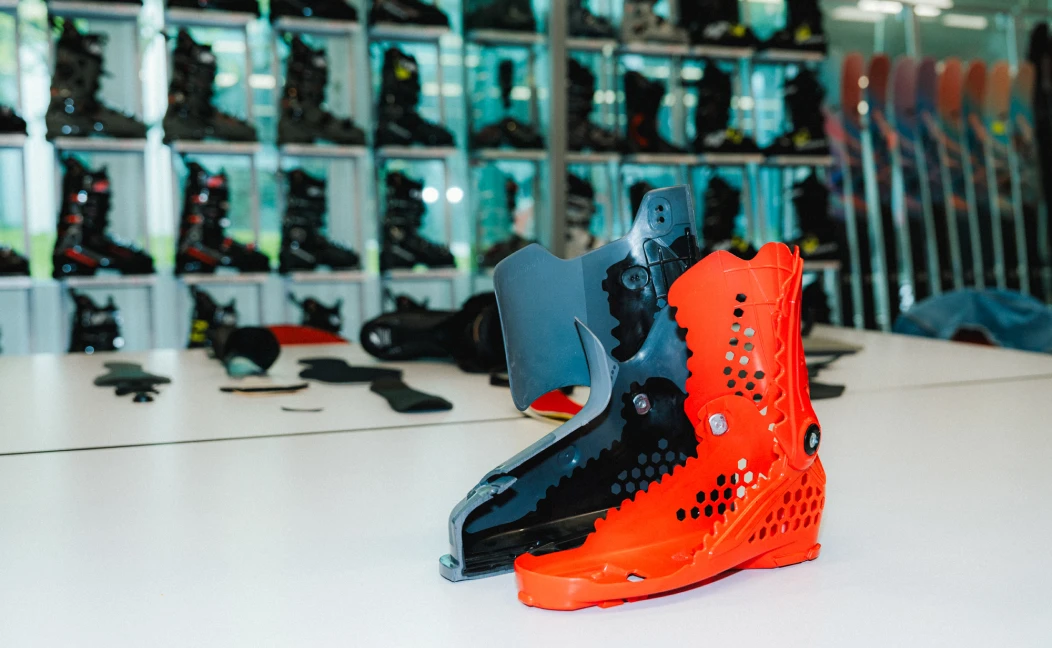
It was toward this last image that, at a certain point, Nordica's team of creatives turned their gaze in developing the structure of the Machine Family shells, seeking—through the replication of the honeycomb's cellular structure—that ancient and revolutionary union between aesthetics and function which has always represented the path to follow and the goal to reach in any creative practice worthy of the name. Function, the engineers must have murmured, subtly overcome by their own wonder, before the prototypes just out of the molds. Of this I am certain.
The honeycomb-cell structure I speak of is the photograph of a story that comes from far away, an intermediate evolutionary stage that, on closer inspection, can help us understand where we have come from and where we are heading. It is the essence of Art, but it is also the essence of what we call Evolution: nothing ever stops, ever.
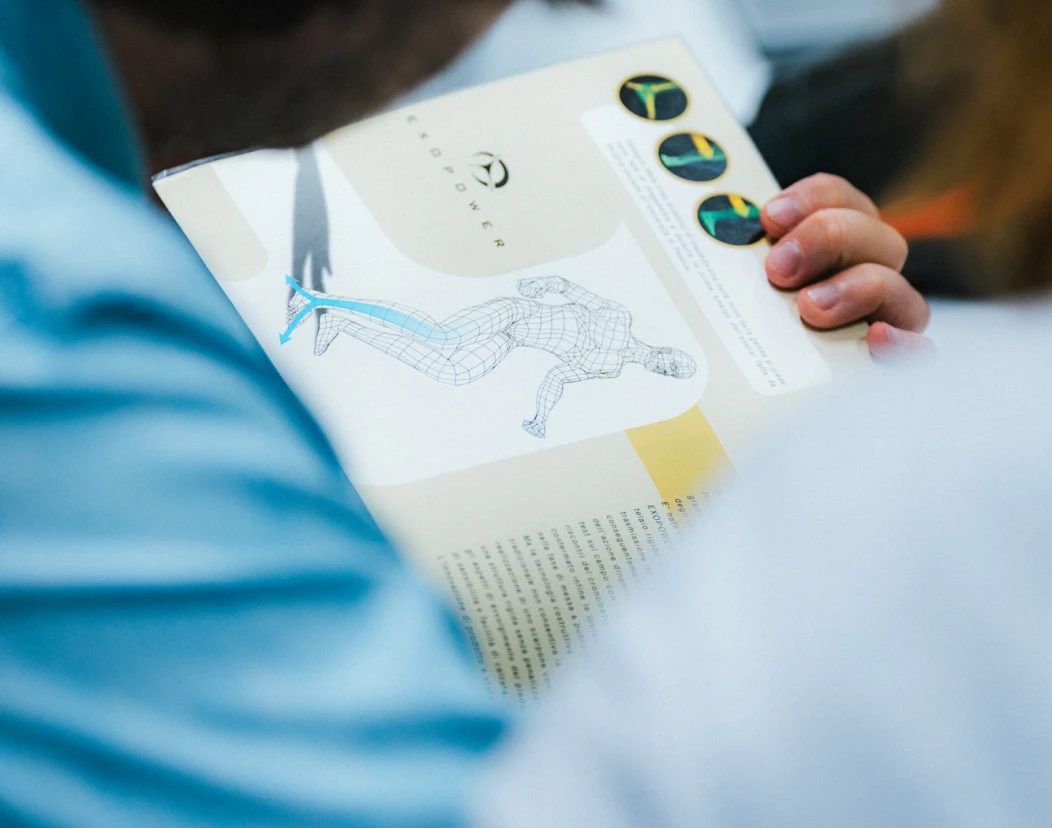
Art, Evolution, Technology. The story of how a form of beauty met its function in Nordica's laboratories begins toward the end of the 1990s, when the Exopower model makes its debut on the market. Its principal technical feature is an insight that then found its way down to the present day: the use of a plastic bi-injection process in the mold of the shell, which made it possible, from that model onward, to employ two materials to resolve the disparities in thickness and rigidity that came from using a single type of plastic.
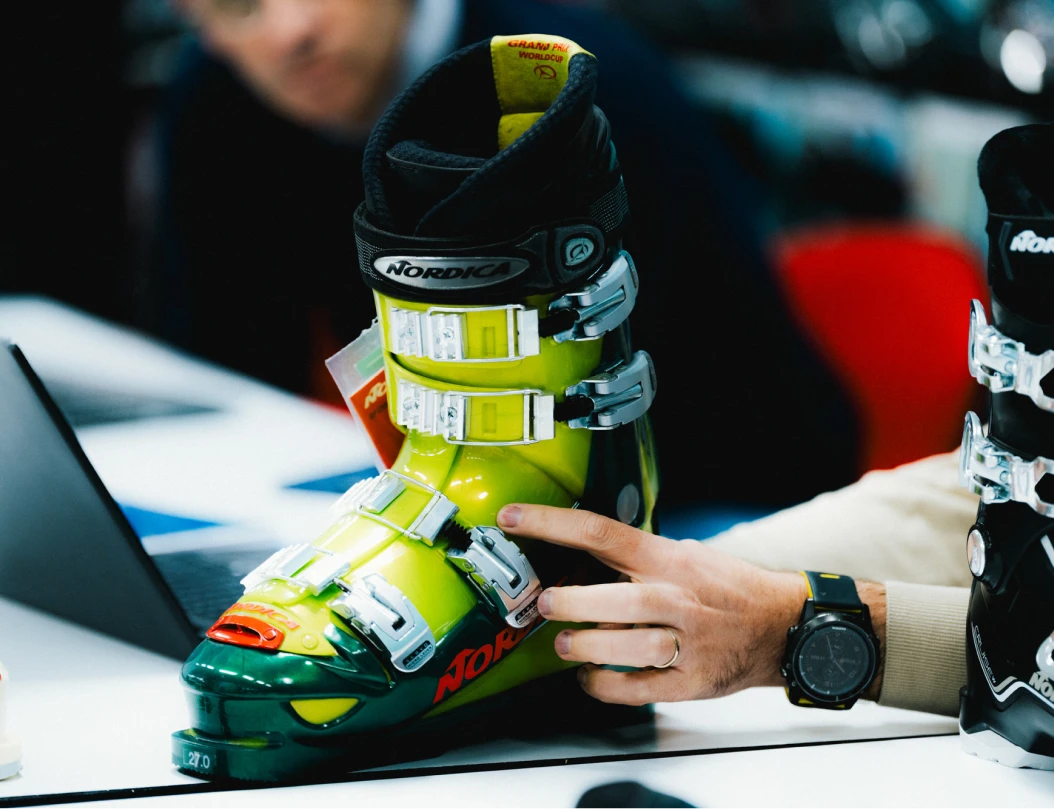
In the Exopower, the second material was grafted onto the first by means of a more rigid exoskeleton structure, which traced across shell and cuff a characteristic lambda shape (this indicated, like a kind of map, the three lines along which forces are distributed over the boot). We are speaking of an era in which production technologies were not as optimized as they are nowadays: the molds through which the plastic was given form distantly recalled the first fifteenth-century printing systems—machines resembling mosaics—and one can therefore think of Exopower and its technical innovations as a sort of Gutenberg Bible, as far as the idea of bi-injection is concerned.
It is with the dawn of the 2000s that this idea undergoes its first evolution: into the Nordica catalogue comes the first generation of the Speedmachine, which marks a change of pace from the production standpoint, transforming the Exopower system into the first version of today's 3Force technology. The steps forward are significant: the points of contact between the two materials are redrawn according to a more functional logic, accompanied by a particular aesthetic care. The transparent plastic parts set themselves the goal of showing off the advanced technologies and the expertise hidden behind the finished product—and it is not at all surprising to discover that, in the creative process, artists and designers of the caliber of Giorgetto Giugiaro were consulted.
In the mid-2010s the second generation of the Speedmachine arrives on the market, and skiers all over the world are thus given the chance to experience firsthand the further qualitative leap—not only aesthetic, but also in the efficiency of 3Force technology, which in Nordica's laboratories has never ceased to be refined and optimized. The interaction between the plastics at their points of contact is improved still further, with particular attention to a correct handling of thicknesses, and the idea of the exoskeleton begins to evolve into the far more effective one of a "skeletal" structure, wholly or almost wholly internal to shell and cuff.
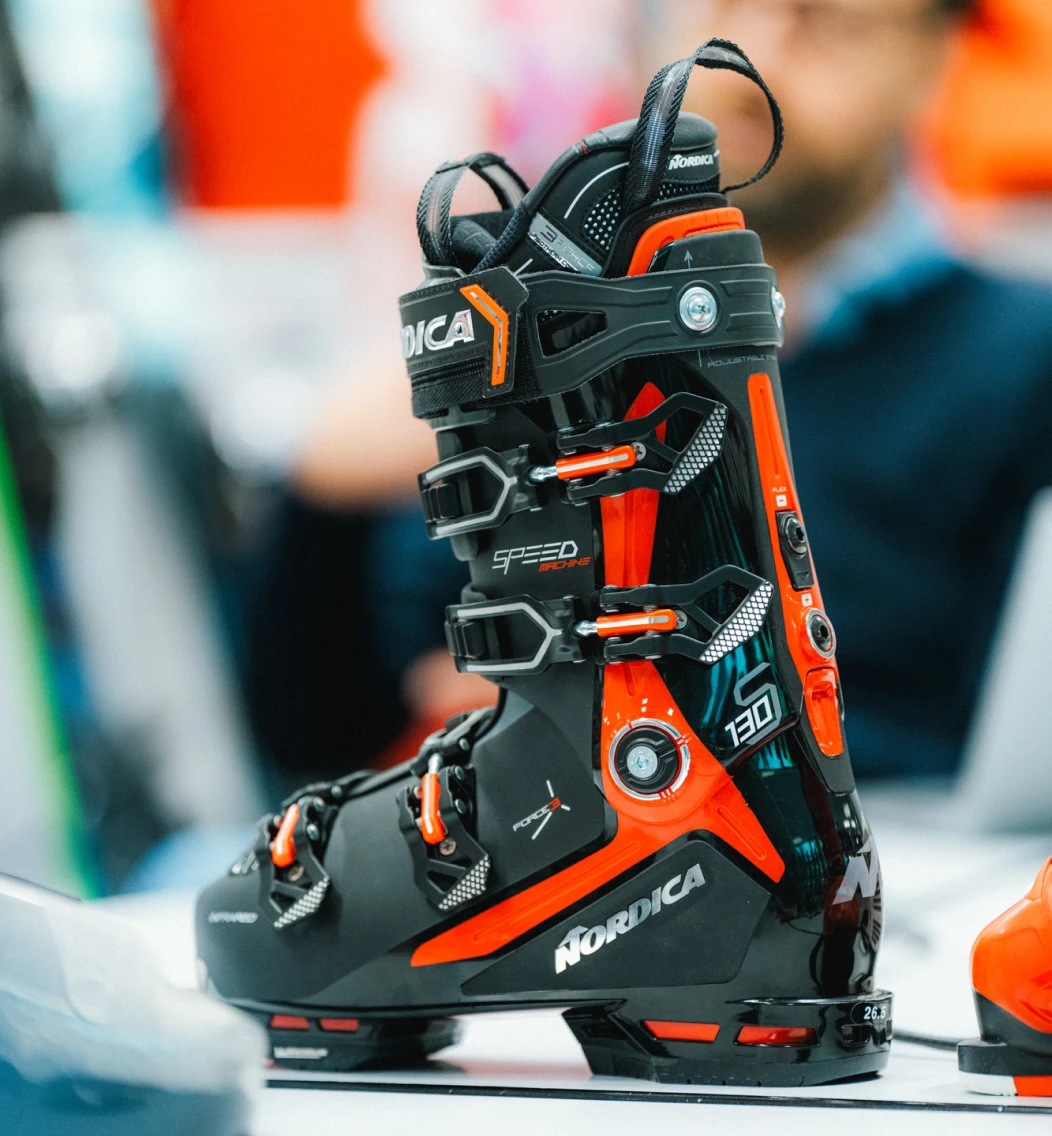
But it is with the third generation that this technology comes to the full realization of its function.
Released in the very midst of the Covid-19 pandemic, the third Speedmachine wholly internalizes the lambda conformation, and the rigid material it is made of becomes the boot's skeleton, optimized to deliver maximum performance, in terms of solidity, while skiing. The design of the shell keeps a record of this evolution, and the more rigid structure is kept visible on the boot's livery through "little windows" cut into the softer outer plastic—an idea in some respects similar to the one found in the soles of Nike's iconic "Air" line of sneakers. But it is in the interaction between the plastics that the true conceptual quid of bi-injection is to be found, and so we return to that image of the honeycomb from which the story set out. By replicating the honeycomb's cellular structure, in fact, Nordica's creatives managed to find, in the natural solidity that such an arrangement of forms guarantees, the turning point for the further optimization of the boot's performance on the slopes.
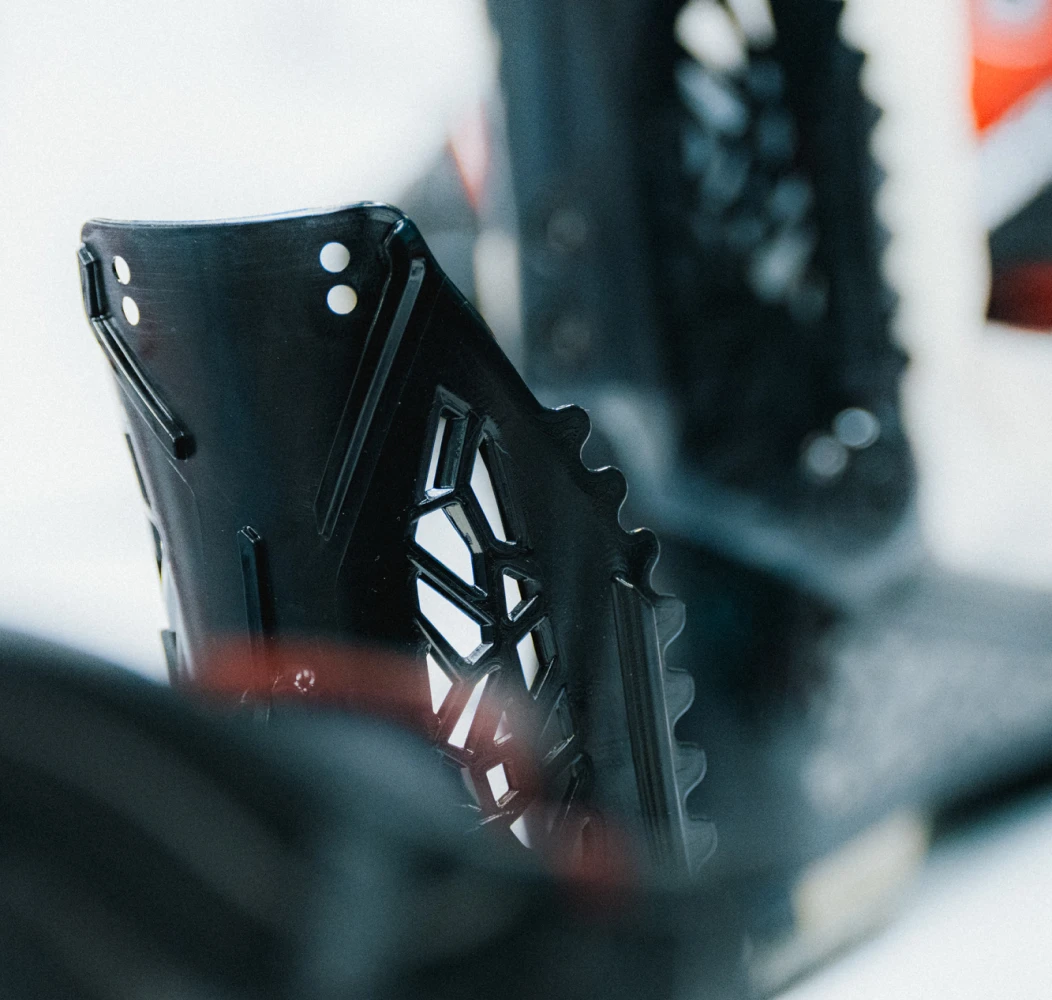
But if it is true, as someone once said, that art imitates life, it can sometimes happen that this connection comes about through a fortunate coincidence—that a creative's effort to make something beautiful and functional ends up, by pure chance, resembling something that nature had already given shape to. In the development of the Promachine, the natural and further step forward along the long evolutionary ladder toward excellence, a collaboration with the University of Trento allowed Nordica to devise a system of interaction between the plastics even more efficient than the honeycomb structure, thanks to the use of generative design practices. The new structure, conceived according to a principle that aims to maintain the same rigidity at a reduced weight, is described to me by the engineers as resembling the internal structure of bone.
Function. Aesthetics is subordinate to it, becomes a happy consequence of it within a journey that involves, yes, an artistic search, a desire for beauty—but that always places before them a profound sense of necessity, of logic, of usefulness.
While talking with the artisans, at a certain point, I asked a question about the design of Nordica boots that must have struck everyone as a little naïve—a question an artist, perhaps, would have asked. "A ski boot isn't a sculpture," one of them answered me, pleasantly embarrassed.